


The 2019 season in our little Bay was an interesting one. During certain windows, it was some of the best fishing we’ve ever had for stripers 40″ and up.
The ‘Three Bays”—made up of Plymouth, Kingston, Duxbury—are an absolute mecca for light tackle and fly fishing. If you’ve never fished the many channels, rips, eelgrass beds, flats, and structure points here, check this blog post out to get educated.


This fishery is due in large part to a huge population of very willing schoolies who will, on most mornings, participate in massive surface feeds on the acres of resident bait around the flats. And in past years, there was always a few rogue 32”-40” fish that kept these feeds real interesting.
In the past five or six years, we’ve watched as these schoolies got larger, until they reached that magic length of 28” in 2018. And then this season, they were gone. Vanished. Could it have been that they up and left the Bay when they got to a certain length/age? Maybe. But the dozens and dozens of boats I saw in 2018 set up in the productive rips with a livewell full of mackerel tells a different story.
This is only true if you prescribe to the theory that biomasses of striped bass typically migrate to the same locations year after year. Capt. Brian Coombs and I talk about this extensively in our first podcast if you’re interested in learning more about it.
But let’s not get too negative. It was an excellent year in PlymDuxTon, all things considered. We learned some things. We caught lots of bass in a bunch of different ways and new locations. We got a bunch of people on their FIRST EVER STRIPED BASS! Here’s my review of the 2019 fishing season in the Three Bays.


An early start


Like the rest of the Northern reaches of the striper coast, we had a relatively early start to our 2019 striper season. You expect to find stripers down on the other side of the Canal in the first two weeks of April, but not along the South Shore.
But find them we did—and in some ridiculous numbers. They weren’t just the typical maybe-resident, maybe-migratory micros, either. We hooked into some good fish on mackerel and plugs around the inshore bay spots during that first wave of fish.
The timing of the Spring run can never really be predicted. I’ve talked to other fishy folks and, while they have their theories, you can never really guess when the fish are going to show up in the spring. Early warm weather helps of course, but it’s without a doubt not the only determining factor. Maybe we’re seeing a trend and we’ll start getting these early waves of fish in our areas more consistently.
Lots of resident small fish, no cookie cutters

While the initial push was good, throughout the months of May and June, we started seeing a troubling trend: We found almost no 28”-32” fish (and the larger fish, which we typically don’t see in great numbers in our Bay, were missing from the outer CCB areas too). Most mornings, we found heaps of micros up to schoolie-sized fish feeding around the flats. But those really fun cookie cutter 30” fish were strangely missing.
Incoming tide was hot hot hot


The hot tide seems to change slightly every year. Is it the types of bait the fish are on predominantly during that season? Other environmental factors? Pure randomness? I have no clue. But what I do know, is that while the outgoing tide has been money around the rips in the interior of the Bay for the past five years at least, we had almost all of our big fish and feeds on the incoming—especially out front around Browns Bank.
We saw less blitzes on small bait as the season went on. Incoming tides–especially during South and West winds and during big moon tides–brought the mackerel in toward the shoals. This is where we’d find the bass.
The great pogie massacres of 2019


Some time around mid-July, the pogies showed up big time from Manomet to Duxbury Beach. The schools were massive. And it wasn’t just in our Bay. The pogies stretched from Cape Cod Bay up to Maine.
For the first week or so, it seemed like it would be a repeat of the past few years—lots of pogies but no bass on them. But suddenly, one afternoon, the cows came home. Fish up to 35-pounds crashed the schools. It was pandemonium. This lasted for two weeks. The fish weren’t always feeding actively, but if you searched the schools in the vicinity, you could find the bass.

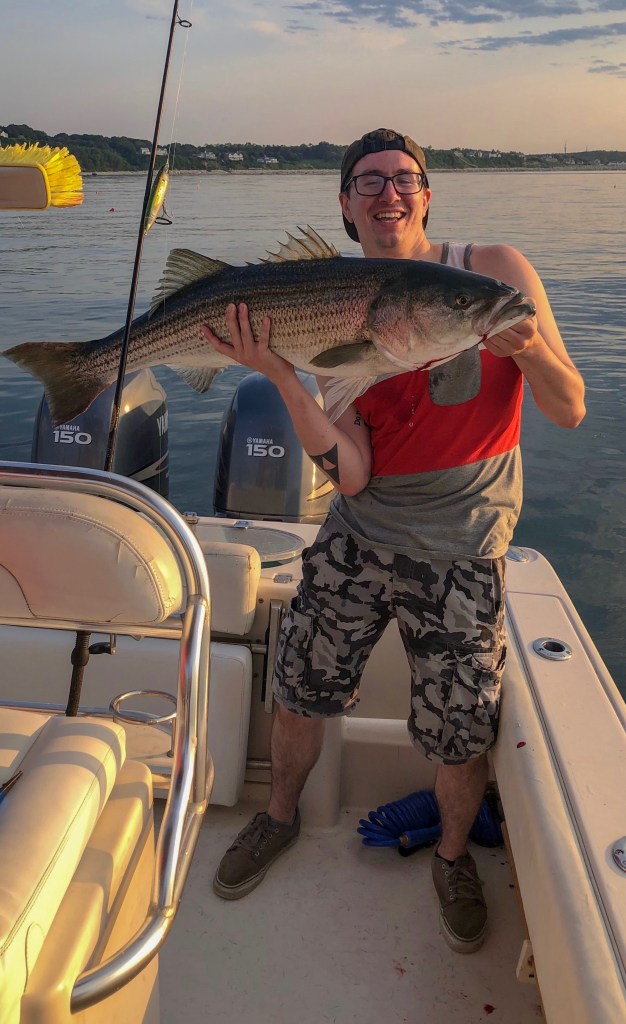
One morning, Capt. Teddy, Dave and I hit up the schools tight to Duxbury beach and we found some of the biggest bass of the season. But suddenly, the schools started acting…differently. They all began to shimmer. Then they were jumping clear out of the water. Six breakoffs and a few half-chomped pogies later, we realized the yellow-eyed devils had arrived. The schools stuck around for a few more days but spread out when more blues showed up. This cycle repeated three times throughout July and August, with Charlie even showing up to break a few reels and dump a few spools of braid.
An early fall run


When the pogies disappeared, the small bait filtered out of the estuaries and rivers. By mid-August, the tell-tale Fall run blitzes begain popping up all around the Bay. For a few days, we had all-day blitzes along Plymouth Beach. Fish of all sizes swarmed in along the flats and crashed bait on the surface. Tiny rainbait, bay anchovies, and juvenile herring received most of the onslaught.
One afternoon during a midday blitz, I watched as a 40”-plus fish came right up, thought about eating my fly, and turned at the last second. I still think about that damn fish. But we probably caught a hundred of bass that day so I can’t complain too much.
The Crescendo

By the end of September, these Fall blitzes began winding down, which isn’t always the case but was certainly earlier than expected. One very windy morning in early October, we chased skittish bass under birds for close to the entire tide. The weather deteriorated, and as a last ditch effort, we chased a far off bird pile around the powerplant.


Suddenly, stripers and blues were slashing juvenile herring and peanut bunker all around the boat. Wolf packs of stripers chased every single spook plug and fly. Blues thrashed and puked chunks of baitfish all over the boat. Big gorilla blues and keeper stripers were hanging deep under the pools, tearing apart the soft plastics we dropped down to them. The blitz lasted through slack, and the fish didn’t mind. The wind and surf energized these transient fish, turned them into crazed eating robots among the wild-eyed schools of young baitfish. The next morning, they were gone from our Bay.
The ride back was wet, but we didn’t mind. It was the last blitz we saw in the Three Bays. Resident fish hung around the harbors and eventually retreated into the rivers when the waters got cold.
How was your year in the Three Bays? Let us know by leaving a comment below.